A BETTER MAULSTICK
Painters often use a maulstick to steady their hand when working on details. The Dutch word "maalstok" means "painter's stick". The traditional maulstick has a bulb on the top covered with leather or cloth, and it rests on the edge of the canvas. Some people stick a tennis ball on the end of a dowel. There are two problems with this approach.
First, you must continually be aware of the location of the ball, being sure it does not slip off the edge of the canvas, or slide into the painting. Second, when you stop to rest or observe your work, you must find somewhere to place the stick. The solution is easy.
Just use a walking cane. A walking cane will hook over the top of the canvas or easel, and the curve of the handle will keep the cane away from the paint. When you need a rest, just let go and the cane will stay in place. The bottom of the cane will rest on the bottom edge of the canvas - you don't have to hold it up with your hand.
A simple, yet elegant solution.
PHOTO EXPOSURE PROBLEMS - A SOLUTION FOR ARTISTS
Recently someone asked about problems with underexposed images on a camera. Sometimes if you are at a gallery reception, messing with the f-stop is too much of a hassle, and the "Auto" setting can result in underexposed images. An excellent way of dealing with the exposure problem is to process the photos on your computer using free image touch-up software.
One program I use often to modify my photos is UFRAW. UFRAW assumes you take your photos in RAW format. It is free on-line, and is a super program. It will lift the exposure and let you modify many other parameters, such as green level and interpolation. It features a live histogram to monitor your changes. RAW format bypasses the camera's built-in image processing, so you are working with the data directly from the sensor. http://ufraw.sourceforge.net/
Another great program for use with photos is GIMP. I use it all the time. It is free to download (I use it on Linux, so I'm not sure how it works on other platforms - but I have heard from other artists that it works fine). GIMP will do cropping, resolution, resizing, brightness/contrast, animation, special effects, and a zillion other things. It will work in any format including jpg, which is what most cameras use. However, it will not directly work with RAW since RAW is semi-proprietary, but can import RAW using UFRAW. http://www.gimp.org/
With these two free software programs, you can do just about anything imaginable with your photos. I know one artist that uses GIMP to create unusual special artistic effects on her photos, which she then sells in galleries and art shows!
MAKE YOUR OWN NO HOLES CANVAS - STEP ONE
I received an email from a painter wanting to know how to mount your own canvas without using staples. I thought I would describe the process in steps, and include photos. Here goes: start with a sheet of birch plywood cut to the size you need for your painting. 1/4" birch ply... is available at most lumber stores. 1/8" is lighter, but you might have to order it. After you have cut your plywood to size, use a miter saw (or chop saw) to cut 45 degree angle corners of basswood strips for use on the sides of the painting. Basswood is light, but strong. I rip saw my basswood strips at 3/4" X 3/4".
I will post STEP TWO in a few days. Please let me know if you have any questions.
Our Monitors are Fooling Us
Over the past year, many of us have replaced our CRT computer monitors with LCD monitors, creating a significant problem for artists. LCD monitors are thin and light, and may produce less eye fatigue because they to not have the scan refresh lines of a CRT. For most users, these are definate advantages. However, for artists there is one major drawback with the LCD monitor. LCD monitors typically reduce the number of bits available for each color from 8 to 6. Computers are capable of generating 24-bit "true" color - 8 bits for each of the three colors on each pixel, or 16,777,216 colors. In contrast, most LCD displays are limited to 6 bits, and will display only 262,144 colors. To correct for this problem, monitor manufacturers use a technique called dithering, where two pixels display slightly different colors in order to trick the eye into thinking it sees a third non-existant color.
In addition, monitor manufacturers often heighten the constrast of the display, so that it will look better on the shelf of the computer store. One manufacturer even boosts the blue in the display so that the whites look whiter. All of this becomes significant when an artist is trying to photograph art work and use the monitor to predict what others will see. Preparing images for printing is especially challenging. To the trained artist eye, the LCD monitor is always missing something of importance. This is because certain middle shades are being dropped, and colors are merged. For less complex images, this may not be much of a problem. But when displaying wider variances of hue, chroma, and value, the effect can sometimes be shocking. It is important for artists to be aware of these issues when preparing their artwork for a wider audience on the Internet or in print media.
Green Acrylics?
Acrylic paints often contain small percentages of formaldehyde or ammonia as preservatives. These can cause allergic reactions in some individuals, especially if they are using large amounts of polymer medium or gel. Such artists may benefit from the use of gloves and a ventilation system in the studio. However, another issue should be considered when choosing acrylics for use in art.
For some time, the EPA has been concerned with the number of toxins produced in the overall manufacture of acrylic polymers. Roughly 36 billion pounds of toxic solvents are used each year in the production of acrylics. Much of this is used in the manufacture of textiles, but toxic solvents are also used in the production of paints. To address the problem, the EPA has funded a "green initiative" in hopes of finding less toxic ways of making acrylics. For a summary of the issue, visit: http://www.jeccomposites.c
Keep in mind the pigment issue as well. Cadmium is carcinogenic. It doesn't matter if it is in acrylic paint or oil paint.
The Color of a Culture
Can a culture develop an identity around certain colors? In the case of Indian Yellow, it appears to be the case. Indian Yellow, a beautiful yellow with overtones of vermilion, has been worn in India for centuries. Some say the process for making it was brought to India from Persia in the 15th century.
Making Indian Yellow supposedly involved collecting cow's urine, boiling it over an open fire, and collecting the pigment into balls. The process was reportedly outlawed in 1908 due to the harmful mango leaves and turmeric fed to the cows. However, in recent years, researchers have concluded that Indian Yellow may have been made from a vegetable. No conclusive evidence of how it was originally made has been found, but everyone agrees it is beautiful. Anyone who has traveled to India can attest to the ubiquity of Indian Yellow in the culture. It seems impossible to imagine an India without it. Yet no one is sure what it is...
Today, the hue for Indian Yellow is made with modern pigments: nickel azo, hansa yellow and quinacridone burnt orange.
Unusual Textured Gesso Effects
Many people use Masonite or birch boards rather than canvas for painting supports. Usually, artists use boards because they desire a smooth surface, allowing for great detail. But sometimes there may be a reason to create a textured surface for interesting and unusual effects. One way I have discovered to do this is by using a foam roller, purchased from the hardware store, to apply the ground or "gesso". By varying the amount of gesso used, it is possible to create rather interesting and useful textures. Sometimes, gesso that has become "stiff" will result in small craters on the board - interesting to experiment with. As an aside, it is probably good practice to use a board as support for canvas, to reduce the flexibiliy of the canvas which can lead to problems with paint cracking.
the Mystery of Sfumato
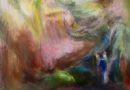
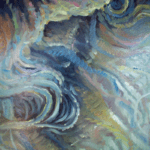
Much of today's art places stress on bright colors and strong sharp lines. In a gallery the "high contrast" look will always stand out, leaping off the wall. However, there is something lost in this clarity - the sense of distance, the sense of fading mystery. Few painters in our times are aware of a technique called "Atmospheric Perspective" where objects in the distance are less distinct than objects close up. To create this effect, an artist will use colors toward the gray range, rather than the stronger more saturated colors. Painters in the past often used either a layering technique, or a stippling brush to apply the subdued colors. The technique is called sfumato. Leonardo used sfumato, but many other artists have used it even more extensively. For example, the image you see attached here is a painting by J.M.W. Turner, who made a whole career out of sfumato. Turner used light to express God's spirit and so he left out solid objects and details. What do you think? Is this ancient technique useful? Would a bit more mystery in our art be a good thing?
No More Toxic Solvents - Here's How!
Some artists are still cleaning their brushes in a jar with of Odorless Mineral Spirits, creating a toxic sludge that must be taken to the chemical recycling center. Here's a better way:
1) Go to the grocery store and buy a roll of freezer paper. It has a slick side that will prevent the paint from soaking into the paper.
2) Cut a piece of the freezer paper to wrap around a board. Any board will do. Cardboard, plywood, and craft board all work fine. Tape the paper to the board on the back side.
3) Mix your paints directly on the freezer paper with your palette knife. If needed add a drop of your medium, such as Linseed oil or Spike Lavender oil. Wipe the knife with toilette paper.
4) When changing colors, wipe your brush with toilette paper, or stroke your brush on the paper palette.
5) When you are done, fold the palette paper up and dispose of it or take it to recycling, depending on whether your pigments are toxic. You won't have to wipe your palette board off with solvents. NO OIL SOAKED RAGS TO CATCH ON FIRE.
6) Clean your brushes with soap. Old chunks of hand soap will work fine. Recycle! This assumes that you are using non-toxic pigments in your paints. For example titanium white artist paint is made from the same pigment used in toothpaste. If you are using toxic paints such as those with with lead or cadmium, the leftover pigment water should be taken to recycling.
7) That's It! No toxic solvents to mess with, during or after painting.

The Self Destructing Painting
Recently, while visiting an upscale gallery to look for new art, I came across a painting that I enjoyed very much. Wanting to learn about the artist's technique, I looked close at the brushstrokes. Suddenly I realized the painting was falling apart! Actual hunks of paint were peeling off the surface of the canvas. Looking further, I discovered that all of the peeling paint was white. This was indeed a mystery. I said to myself, "Why white?" I then remembered that one of the most common pigments used in artist paints should probably never have been used at all. It is called Zinc Oxide, and it causes oil paint to de-laminate. If the artist had used a different white paint in his painting, It might have lasted 100 years. But now, unfortunately, it will probably never be sold.